
What should you do after an elderly parent falls?
First check for injury and do not lift them yourself; call your emergency number if they may have hurt their head, back, neck or hip or cannot get up. Then book a doctor's visit about the fall, and within the week fix the spot where it happened and the route they walk at night.
The first part comes from the NHS falls page (reviewed 2025): keep the person comfortable and warm, help them up carefully only if they can, and see a GP after a fall. The CDC's own fall prevention steps (reviewed 2026) add a medicine review, a yearly eye check and leg-strength and balance exercise. The house is one step of four.
This is general information, not medical advice. Talk to your clinician.
Honest limits, before anything else
- This page and the calculator are a planning aid. They cannot tell you why your parent fell. Only a clinician can look at that.
- RoomMend, which we make, organizes notes and fix plans. It is not a home inspection, safety certification or fall-risk assessment, and it does not detect hazards in photos.
- "Reported completed" in RoomMend means someone said the job was done. We do not verify it, so the 30-day recheck matters.
- Grab bars, rails and anything electrical need a qualified installer.
A mini story: the call on a Sunday morning
Dad slipped on the hallway rug on his way to the bathroom at 4 a.m. He got himself up, felt silly, and mentioned it two days later "so you don't hear it from someone else." He says he is fine.
Here is what the next week can look like. You book him in with the doctor and bring a list of his medicines. On Saturday you walk the house with him, not around him. The hallway rug gets taped down or rolled up, a plug-in nightlight goes between bed and bathroom, and the lamp moves to where he can reach it from the pillow. The tub, which he admits is "a bit of a climb", goes on the list for someone who installs grab bars properly. You both agree to look again in a month.
Walk the house with them, not around them.
How to fall-proof a parent's home in 3 steps with RoomMend
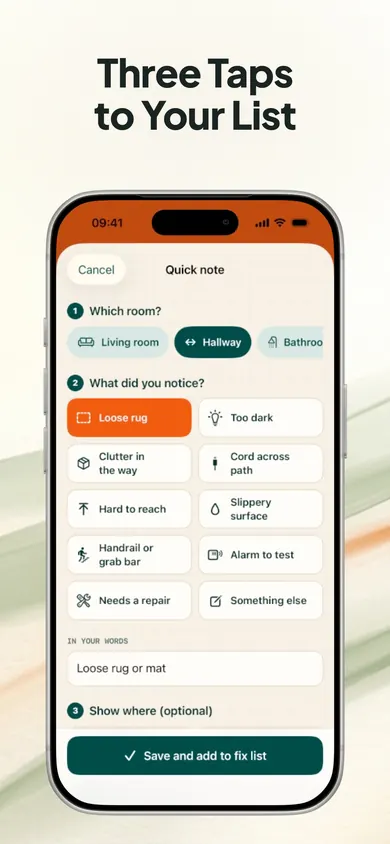
- Note it where it happened. Pick the room and tap the issue: Loose rug, Too dark, Cord across path, Hard to reach, Handrail or grab bar. RoomMend suggests the fix; you choose This week, This month or Someday.
- Assign it. On the fix list, add who is doing it and a target date. Jobs move through To review, Planned, In progress and Reported completed.
- Look again in 30 days. Tick a fix done and RoomMend plans a recheck a month later, so the rug that crept back gets caught.
A fall usually has more than one cause. The list is how you keep track of all of them.
Who RoomMend is not for
If you want automatic fall detection, a medical alert pendant or a smartwatch feature is the right category; RoomMend does none of that. If your parent needs a full home modification plan, ask the doctor about an occupational therapist visit; the National Institute on Aging notes that after a fall a doctor may suggest a therapist or nurse visit to assess the home. RoomMend is for the family member who wants one list for the fixes, shared by Messages or as a room PDF, with nothing slipping back.
Every walkthrough, unlimited rooms and notes, the fix list, reminders, rechecks and room PDFs are free. RoomMend Plus is a one-time purchase for more homes, more photos per room, the whole-home binder PDF and the full timeline.
Reading your calculator result
The calculator sorts what you tapped into two piles. Quick fixes are the ones the CDC's Check for Safety checklist (2017) treats as do-it-yourself: tape or remove a rug, coil cords against the wall, clear the stairs, add a nightlight, move everyday things lower. Get help items involve installing grab bars or rails, which the CDC suggests having someone put in.
It then spreads the quick fixes across your next visit and sets a recheck 30 days later, the same rhythm RoomMend uses. One design decision we made in the app follows the same logic: the home screen shows only one next step, because after a fall the hard part is not knowing what to do. It is doing one thing, then the next.
For context, the CDC says more than one out of four older people falls each year. Your parent is not unusual, and neither is your worry.
Questions adult children ask after a fall
Should I help my elderly parent get up after a fall?
The NHS says to keep the person comfortable and warm, and to help them get up carefully only if they can, without trying to lift them yourself. Call your emergency number (911 in the US) if they may have injured their head, back, neck or hip, or cannot get up.
Should my parent see a doctor after a fall even if they seem fine?
The NHS advises seeing a GP after a fall or if you are worried about balance or mobility, and the CDC suggests asking a provider to evaluate fall risk. A doctor can check balance and may refer to a falls service or suggest a home visit by a therapist.
What should I change in the house first?
Start where the fall happened, then the night route from bed to bathroom. The CDC's checklist focuses on clear floors and taped or removed rugs, lights and handrails on both sides of stairs, grab bars and non-slip mats in the bathroom, and a lamp and nightlight by the bed.
How do I talk to my parent without making them feel helpless?
Ask what they noticed before you say what you noticed. Offer choices (this week, this month, later) rather than a list of orders, and fix one thing together on the same visit so it feels like teamwork, not inspection.
Can medicines make falls more likely?
The CDC suggests asking a doctor or pharmacist to review medicines to see if any might make a person dizzy or sleepy. Bring the full list, including over-the-counter products.
Does RoomMend detect fall hazards?
No. RoomMend organizes the notes and plans you make. It does not detect hazards in photos and is not a fall-risk assessment. Its walkthroughs are based on public CDC, National Institute on Aging, NFPA and CPSC guidance.
Make the first fix this visit
Note the spot, plan the fix, look again in 30 days. RoomMend is free on the App Store.

Updated November 2026
Related
- Where to get a free home safety assessment for seniorsWho offers free home safety assessments for seniors: fire and EMS programs, Area Agencies on Aging, repair nonprofits, plus a check to do tonight.
- Holiday home safety check for parentsHome for the holidays? Walk six spots in a parent's house, front step to night route, with CDC and NIA checks and a 10-minute fix for each.
- RoomMend: a room-by-room home safety checklistA room-by-room home safety checklist for your home or a parent's: note what you notice in three taps, plan the fix, recheck in 30 days.
- Preparing your home for an elderly parent moving inA first-week plan for when Mom or Dad moves in: answer four taps, get a day-by-day stack of room jobs based on CDC and NIA fall guidance.