Where can seniors get a free home safety assessment?
Free home safety assessments for seniors usually come from four places: a local fire or EMS department program, your Area Agency on Aging, a home-repair nonprofit, or a therapist home visit after a doctor's referral. None of them is in every town, so the fastest first call is the free Eldercare Locator, which points you to local services by zip code.
Why bother: the CDC says more than one out of four older people falls each year (page reviewed 2026), and emergency departments recorded about 4.5 million visits for older adult falls in 2024. The CDC also says plainly that falls can be prevented.
This is general information, not medical advice. Talk to your clinician.
The roundup: free home safety help, checked November 2026
Start hereEldercare Locator
A free public service of the U.S. Administration for Community Living. Call 1-800-677-1116 (Monday to Friday, 8 a.m. to 9 p.m. Eastern) or search eldercare.acl.gov by zip code. Ask for your Area Agency on Aging and say the words "home safety" and "home modification".
One phone call, then a local name.
Fire & EMSSenior home safety visits
Some departments send someone to your home for free. Austin-Travis County EMS, for example, offers a free room-by-room visit by a licensed paramedic for residents 65+ who live independently, with a medication review and safety equipment. Call your own department's non-emergency line and ask.
Ask the non-emergency line, never 911.
NonprofitRepair programs
Rebuilding Together affiliates run Safe at Home repairs, such as grab bars, handrails and lighting, aimed at low-income older homeowners. Rules and waitlists are set locally, and you will usually need proof of income.
Assessments that come with the fix.
ClinicalTherapist home visit
The National Institute on Aging notes that after a fall, a doctor might suggest an occupational therapist, physical therapist or nurse visit the home to assess safety (NIA, reviewed 2022). Ask the doctor about it at the next appointment.
The most thorough, and it starts with the doctor.
TonightThe do-it-yourself check
The CDC's free Check for Safety brochure (2017) walks room by room with yes/no questions. It takes one evening and finds the fixes that need no professional at all: a nightlight, tape under a rug, a cleared stair.
You can start before anyone calls you back.
Five fall facts worth knowing before the visit
- 1 in 4+ older people falls each year. CDC, reviewed 2026
- 4.5 million emergency department visits for older adult falls in 2024. CDC
- 43,000+ deaths from falls among adults 65 and older in 2024, the leading cause of injury death in that group. CDC
- 4 steps the CDC lists: ask a provider to evaluate fall risk, review medicines that cause dizziness or sleepiness, have eyes checked yearly, and do leg-strength and balance exercise. CDC, reviewed 2026
- Both sides: handrails belong on both sides of stairs and should be secure. NIA
Home fixes are one of four steps, not the whole answer.
Free home safety assessment FAQ
Who does free home safety assessments for seniors?
It depends on where you live. Common sources are local fire or EMS departments (for example, Austin-Travis County EMS runs free in-home visits by paramedics), Area Agencies on Aging found through the Eldercare Locator, and home-repair nonprofits such as Rebuilding Together affiliates. After a fall, a doctor may suggest a home visit by an occupational therapist, physical therapist or nurse.
How do I find a home safety program near me?
Call the Eldercare Locator at 1-800-677-1116 (Monday to Friday, 8 a.m. to 9 p.m. Eastern) or search eldercare.acl.gov by zip code. Also ask your local fire department's non-emergency line whether it runs a senior home safety or fall prevention program.
Does Medicare pay for a home safety assessment?
We could not confirm a simple yes or no that applies to everyone, so we will not guess. Ask the doctor and your plan directly, especially after a fall, when the doctor may refer an occupational or physical therapist for a home visit.
What does a home safety assessor look at?
Mostly trip and fall hazards room by room: rugs, clutter and cords on floors, lighting and handrails on stairs, grab bars and non-slip surfaces in the bathroom, and a lamp and nightlight by the bed. Some programs also review medications and check smoke alarms.
Can I do a home safety check myself?
Yes. The CDC's Check for Safety brochure is a free room-by-room checklist designed for older adults and families. A self-check does not replace a professional visit when someone has already fallen, but it finds the easy fixes fast.
Is RoomMend a home safety assessment?
No. RoomMend organizes your own notes and plans with guided walkthroughs based on public CDC, National Institute on Aging, NFPA and CPSC guidance. It is not a home inspection, safety certification or fall-risk assessment, and it does not detect hazards in photos.
Honest limits of this roundup
- Programs come and go with local budgets. We checked the sources linked above in November 2026; your county may have nothing similar, or something better.
- We name one fire-department program as an example, not a promise that yours runs one.
- We could not confirm insurance or Medicare coverage rules that apply to everyone, so we do not state any.
- RoomMend, which we make, is a planner for your own notes. It does not assess anyone's fall risk and cannot tell you a room is safe.
How it works: three steps before anyone visits
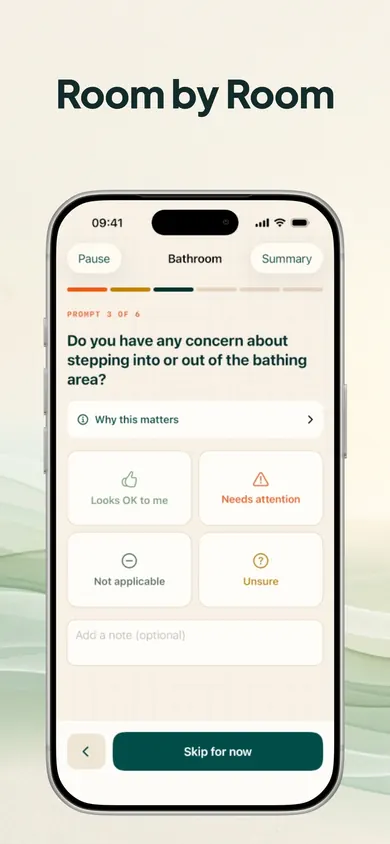
- Pick the home. Apartment, One-floor house or Two-floor house, and the rooms are ready. No address or account.
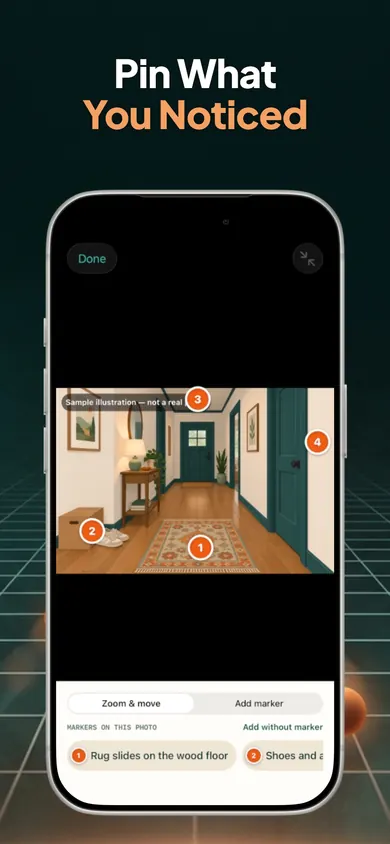
- Walk one room. Use a guided walkthrough, or the three-tap quick note: room, issue (Loose rug, Too dark, Cord across path), when.
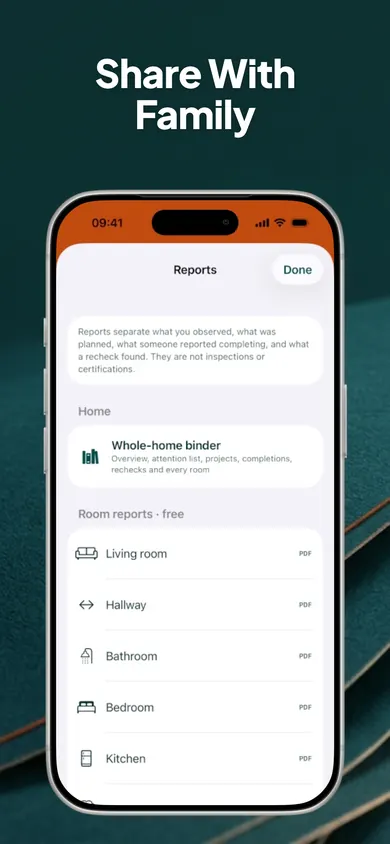
- Share the room PDF. Send it by Messages or email, or print it for the assessor. Tick fixes done and RoomMend plans a look-again in 30 days.
A visit goes further when the easy fixes are already done.
Who RoomMend is not for
If someone has already fallen, the first call is the doctor, not an app. If you need a contractor's opinion on wiring, gas, structure or a ramp, RoomMend will hold the note but cannot replace a qualified professional. And if you want a device that detects falls, this is the wrong tool: RoomMend organizes notes and plans, nothing more. Every walkthrough, the fix list, reminders and room PDFs are free; RoomMend Plus is a one-time purchase for extra homes, more photos and the whole-home binder.
Make the list before the call
Walk one room tonight. Start on your iPhone with RoomMend from the App Store.

Updated November 2026