Day 1 Bedroom and the night path
A lamp reachable from bed, as CDC's Check for Safety checklist (2017) suggests, and a night light so they can see where they are walking. Lie on the bed and reach for the switch yourself.
 RoomMend · first-week plan
For adult children making room for Mom or Dad: four taps, then a day-by-day job stack.
Pick your home type to build the week.
 Free on iPhone · no account
Your seven cards appear here after the first tap above.
Start with the path your parent will walk most at night, bed to bathroom, then the bathroom itself, then stairs and entrances, one room per evening, writing down every fix as you go. That is the whole idea of the stack above: the order follows how a day is actually lived, not how a house is laid out.
Why the night route first? CDC's older adult fall data (reviewed September 2026) says more than one in four older people falls each year, but less than half tell their doctor, and that falling once doubles the chance of falling again. A new house is unfamiliar in the dark. Light and a clear floor are cheap and can be done before the moving van arrives.
A house does not get safer in a weekend. It gets safer one written-down fix at a time.
A lamp reachable from bed, as CDC's Check for Safety checklist (2017) suggests, and a night light so they can see where they are walking. Lie on the bed and reach for the switch yourself.
A non-slip mat or strips in the tub or shower. Note where grab bars should go: NIA says near toilets and on both the inside and outside of the tub and shower. Book installation; do not improvise.
NIA's advice is plain: don't use throw rugs or small area rugs. Cords across a walkway go along the wall. Clutter on the stairs goes in a basket at the bottom.
Handrails on both sides of the stairs and as long as the stairs, per CDC's checklist. A light switch at the top and the bottom. Check the front step after dark.
Move their everyday mugs, plates and food to waist-to-shoulder height. A step stool is a fall waiting to happen; a lower shelf is not.
Test the smoke and carbon monoxide alarms. Put a charger by their bed so the phone is never across the room at night.
Once they arrive, walk each route together at night. They will spot what you missed. Write it down, set a date, and look again in a month.
Make the route from their bed to the toilet safe before the first night: a lamp they can reach from bed, a night light along the way, nothing on the floor to trip on. The National Institute on Aging's room-by-room advice starts with exactly these basics.
Usually the bathroom and the path to it. NIA advises grab bars near toilets and on both the inside and outside of the tub and shower, and CDC's Check for Safety checklist asks for a non-slip mat or strips in the tub.
Rarely in week one. Most first-week jobs are moving things, adding light and buying a bath mat. Installed grab bars and stair rails are bigger jobs; book a qualified installer, and ask an occupational therapist if mobility is a real concern.
NIA's advice is not to use throw rugs or small area rugs. CDC's checklist allows double-sided tape or a non-slip backing if a rug stays. Rugs on the parent's daily routes should be the first to go.
Every walkthrough, unlimited rooms and notes, the fix list, reminders, rechecks, side-by-side compare and room PDFs are free. RoomMend Plus is a one-time purchase for more homes, more photos per room, the whole-home binder PDF, the before/after slider, annotated image export and the full timeline.
No. It organizes your own notes and fix plans. It is not a home inspection, a fall-risk assessment or a medical tool, and it does not detect hazards in photos.
Yes, in a low-tech way: RoomMend can send the fix list as plain text by Messages or email, or make a PDF for one room, so a brother three states away can see what is planned and what is done.
CDC's Check for Safety is free and solid. It has no place to say who is fixing what by when.
Everyone sees it. Nobody can find the bathroom thread two weeks later.
Room walkthroughs, a fix list with owners and dates, photo markers and a 30-day recheck. iPhone only.
Who should pick something else: if your family runs on paper, print the CDC checklist and tape it inside a kitchen cupboard. If you need a professional assessment, look for an occupational therapist rather than any app.
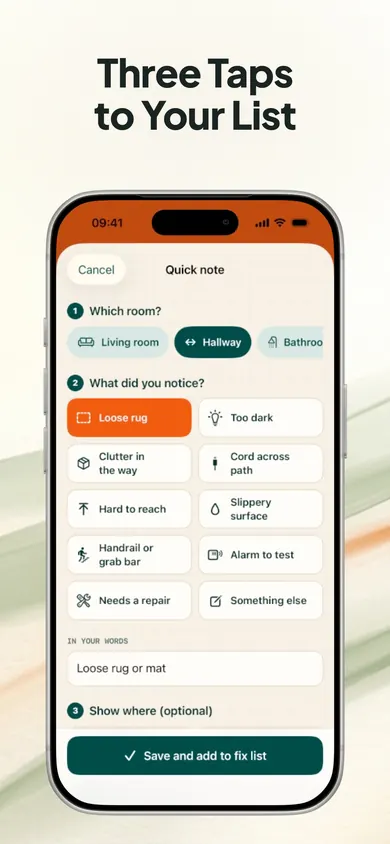
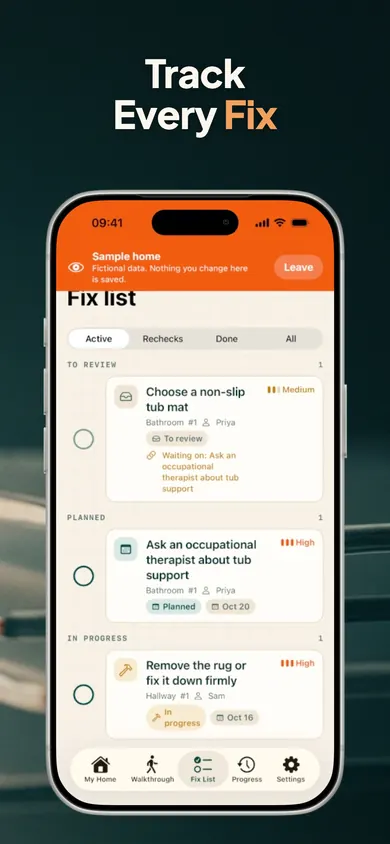
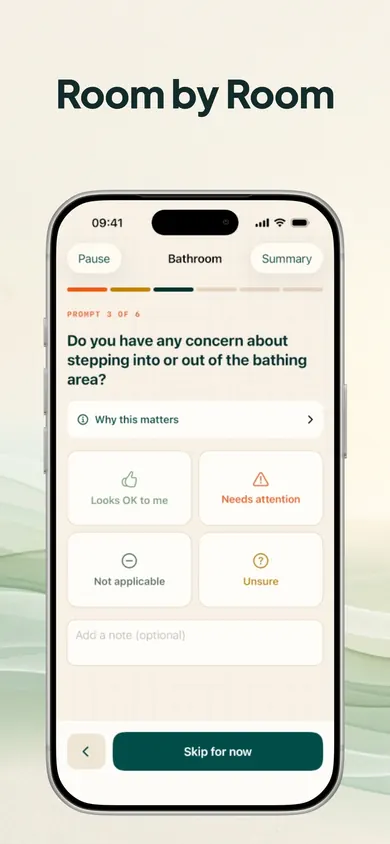
A son clears his study for his mother, who uses a cane. He fits a grab bar, buys a new mattress and feels ready. On her third night she calls out from the hallway: the bathroom is two doors down, the switch is at the far end, and the runner he never thought about has bunched under her foot.
Nothing happened. But the fixes, a plug-in night light, the runner rolled up, a lamp moved to the left side of the bed, took twenty minutes. He had simply looked at the house in daylight. One design decision we made: RoomMend's home screen always shows one next step, not a dashboard, because a tired caregiver at 10 p.m. needs one thing to do, not twelve.
Updated November 2026
Pick your home type, walk the night path, and write down the first fix.