
Which multiplication facts should you learn first?
Learn the rule-based facts first, times 0, 1, 2 and 5, and count every turnaround as the same fact; that leaves only 21 of the 100 one-digit facts to practice, and the 9s, 4s and 3s shrink it further.
The grid above does the counting for you. By the end of Grade 3, Common Core states expect children to "know from memory all products of two one-digit numbers" (standard 3.OA.C.7). That sounds like a hundred things. It is 55 once turnarounds count, and 21 once the easy tables are done.
Parents ask
Which multiplication facts should kids learn first?
Start with the facts that follow a rule: times 0, times 1, times 2 (doubles) and times 5 (counting by fives). Together with turnarounds they cover 79 of the 100 facts from 0 to 9, which leaves 21 to practice.
What order should I teach the times tables in?
There is no single official order. Ours: 0, 1, 2, 5, then 9, 4 (double the double), 3 (double plus one more group), 6 (five groups plus one), 8 (double three times), and 7 last. By the time you reach the 7s, only 7 × 7 is new.
By what grade should kids know their times tables?
In US states that use the Common Core, standard 3.OA.C.7 says by the end of Grade 3 students should know from memory all products of two one-digit numbers. Check your own state or province's curriculum.
Do turnaround facts really count?
Yes. Common Core's 3.OA.B.5 gives the example: if 6 × 4 = 24 is known, then 4 × 6 = 24 is also known. Showing a child that 3 × 8 and 8 × 3 are one fact halves the work.
How long should times table practice be each day?
Short and often beats long and rare. A federal practice guide from the Institute of Education Sciences recommends spacing learning over time (IES, 2007). Five to ten minutes a day is a sensible start; adjust to your child.
Does Brainy Bucks teach multiplication?
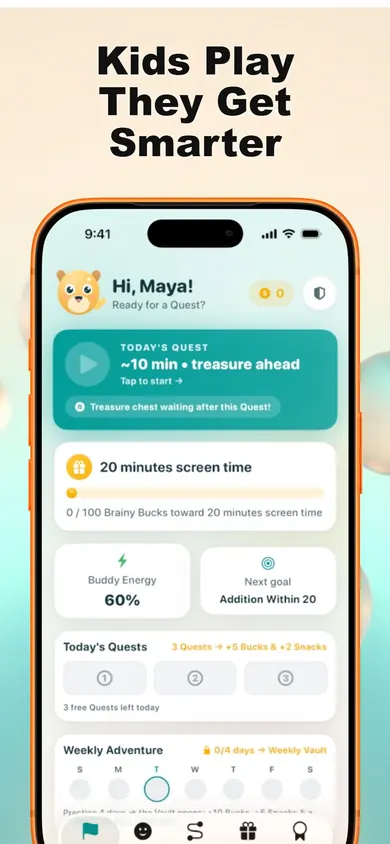
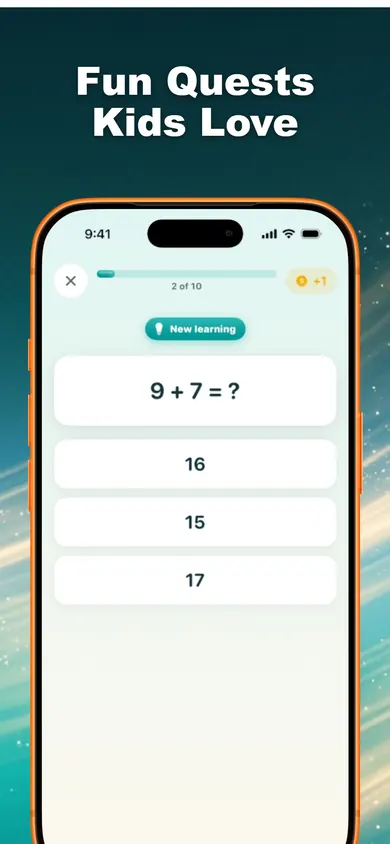
Yes. Multiplication and division are among its math skills, alongside counting, place value, fractions and more. Difficulty adapts to your child's answers, and missed questions come back in later quests. It is not a formal assessment.
The order we suggest, and what it leaves
- ×0 and ×1Rules, not memory. 100 → 64 cells left.
- ×2Doubles your child already knows from addition.
- ×5Counting by fives, like minutes on a clock. 21 facts left.
- ×9The digits of each answer add up to 9 (18, 27, 36...).
- ×4Double, then double again.
- ×3Double it, add one more group.
- ×6Five groups, plus one more group.
- ×8Double, double, double.
- ×7Only 7 × 7 = 49 is new by now.
This order is ours, not an official sequence. Try it in the grid: tap the tables in order and watch the count fall.
A Thursday at the kitchen table (a story we wrote)
She is in third grade and has a multiplication quiz next week. Her dad prints a 100-square chart and she looks at it the way adults look at tax forms. So they turn it into a game: every table she can already say out loud gets crossed off. Zeros, ones, twos, fives. Then the turnarounds. What's left fits on one index card.
They work on three facts a night, five minutes, and put the card on the fridge. By the next Thursday the card has six facts on it, all with sevens and eights.
How to use this with Brainy Bucks in 3 steps
- Find the gap here. Tap what your child knows. Note the facts that are left.
- Do the daily quest. One adaptive Today's Quest is free every day, 5, 10 or 15 minutes, mixing new skills, review and earlier mistakes.
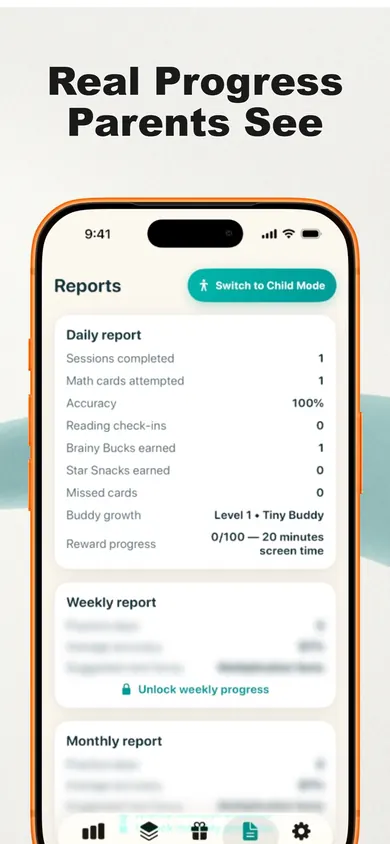
- Read the weekly summary. One plain sentence on what they practiced, and skill statuses from Introduced to Retained.
Flash cards, worksheets or an app?
Flash cards
Cheap and screen-free. Easy to drill only the facts your child already knows, because those feel good.
Worksheets
Good for writing practice. Mistakes come back marked days later, if at all.
Brainy Bucks
A wrong answer gets a clue and a second try, and missed questions return in later quests. No ads, no accounts. iPhone only.
Inside Brainy Bucks
Honest limits
Free every day: one adaptive Today's Quest, 3 extra quests, hints, second tries, spaced review, and the weekly summary and learning plan. Brainy Bucks Plus (monthly, yearly or lifetime) adds unlimited extra quests, the full practice library, weekly and monthly reports and more. Content runs from Pre-K to Grade 8, deepest from Kindergarten to Grade 4. Skill statuses come only from answers given in the app; they are not a formal assessment.
One design decision we made: Child Mode shows no prices or purchase buttons. Rewards are earned by practicing, and nothing is sold to children.
Open Brainy Bucks in the App Store
Use the grid to find the gap, then let one short quest a day close it. Brainy Bucks on the App Store.

Updated November 2026. Standards quoted from the Common Core State Standards for Grade 3.
Related
- Brainy Bucks: a math and reading app for kidsA math and reading app for kids from Pre-K to Grade 8: one free adaptive quest a day, a weekly plan for parents, no ads, no accounts.
- When your child keeps forgetting math factsAced it Friday, blank by Monday? Why kids forget math facts, what a federal research guide recommends, and a one-week story of fixing it.
- Do educational apps actually work? The 2-minute testA 2021 study of 124 kids' apps rated 58% lower quality. Tap through the four research questions that separate apps that teach from apps that entertain.
- Free math and reading apps for kindergarten, comparedFive kindergarten math and reading apps checked against their App Store listings, November 2026: what free really includes and who should pick which.