
What is the best free math and reading app for kindergarten?
If you want everything free with no paid tier, Khan Academy Kids is the strongest pick; if you want a short daily math and reading quest that adapts to your child and sends you a weekly summary, Brainy Bucks is free for one quest a day. We make Brainy Bucks, so read the comparison below with that in mind. Every line about other apps comes from their own App Store listings, checked on the date at the bottom of this page.
Free means different things in each app. The table shows exactly what.
The comparison: what free covers in each kindergarten app
| App | Math | Reading | Free version | Paid option |
|---|---|---|---|---|
| Khan Academy Kids | Yes | Yes | Everything | None (listing: no subscriptions) |
| Starfall | Yes | Yes | Reading basics | $5.99 a month membership |
| Duolingo ABC | No | Yes | Everything | None (listing: no in-app purchases) |
| HOMER | Yes | Yes | Download | Membership, from $7.99 a month or $59.99 a year |
| Brainy Bucks (ours) | Yes | Yes | 1 adaptive quest a day + 3 extra | Plus: monthly, yearly or lifetime |
All five state no ads. Prices are US listings in November 2026 and change; check the listing before you buy anything.
A mini story: five minutes before dinner
A five-year-old who knows her letters but guesses at "sh" and "ch". She can count to 30 and freezes at 3 + 4. Her parent has five minutes while the pasta boils and wants one thing: practice that starts where she is.
In Brainy Bucks, she taps the speaker and hears the question read aloud. She picks the wrong sound, gets a clue instead of a red X, and tries again. Two days later the same sound comes back in a new quest. On Sunday the parent reads one sentence: what she practiced this week and one short suggestion for next week.
In Khan Academy Kids, the same five minutes might be a story and a counting game picked by the app's learning path. Both are reasonable. They are just different jobs.
Pick the app for the job you need done, not for the longest feature list.
How Brainy Bucks works for a kindergartner, in 3 steps
- Pick a 5-minute quest. Today's Quest mixes new skills, review and earlier mistakes. Difficulty adapts to your child's real answers.
- Turn on read-aloud. Tap the speaker to hear any question and its choices, offline. Built for early and developing readers.
- Read your weekly summary. One sentence on what was practiced, plus up to three short suggestions you can accept, replace or postpone.
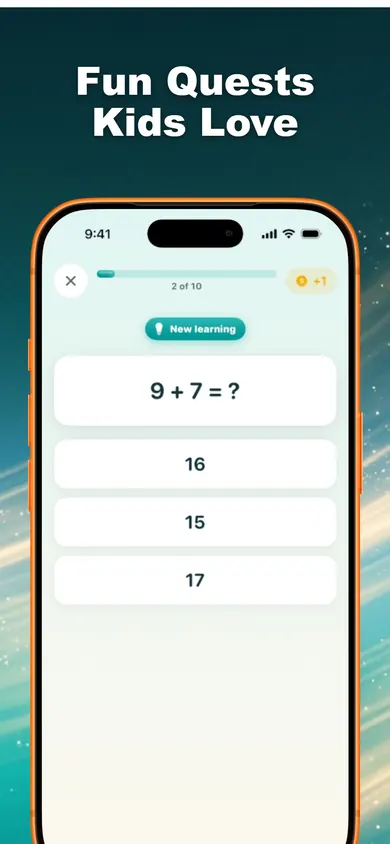
No lives lost and no red X. Kindergarten is the wrong age for those.
Kindergarten app questions parents ask
Is there a completely free math and reading app for kindergarten?
Yes. Khan Academy Kids' App Store listing says it is always 100% free with no ads and no subscriptions, and covers reading, math, phonics and more for ages 2 to 8. Duolingo ABC is also free with no ads or in-app purchases, but it covers reading only.
What should a kindergarten math and reading app cover?
For math: counting, comparing numbers, and early addition and subtraction. For reading: letters and sounds (phonics), rhyming and early sight words. Read-aloud matters at this age, because most kindergartners cannot read the questions yet.
Is Brainy Bucks free for kindergarten?
The core is free: one adaptive Today's Quest every day with no time limit, 3 extra quests a day, hints, second tries, spaced review and a weekly summary for parents. Brainy Bucks Plus is an optional monthly, yearly or lifetime purchase that adds unlimited quests, the full practice library and more reports.
How long should a kindergartner use a learning app each day?
Short sessions suit this age. Brainy Bucks lets you choose a 5, 10 or 15 minute quest; for most kindergartners we would start at 5. Watch your own child: stop while it is still fun.
Can my kindergartner use it without reading?
In Brainy Bucks, tap the speaker to hear any question and its answer choices read aloud, on the device and offline. You will still want to sit nearby for the first few quests.
Do these apps have ads?
According to their App Store listings checked in November 2026, Khan Academy Kids, Starfall, Duolingo ABC and HOMER all state they are ad-free, and so is Brainy Bucks.
Which app is best for a kindergartner who is ahead?
One with a wide grade range, so the content does not run out. Starfall lists Pre-K to Grade 5; Brainy Bucks spans Pre-K to Grade 8, with the deepest coverage from Kindergarten to Grade 4.
Who should pick what
- Want everything free, forever? Khan Academy Kids. Its listing says no ads and no subscriptions, and it adds science, music and social-emotional activities we do not cover.
- Only working on reading? Duolingo ABC is free and focused on letters, phonics and sight words.
- Want a classic, phonics-first site you may know from school? Starfall, if the reading basics are enough or the $5.99 membership fits.
- Want a daily, adaptive math and reading quest with a parent summary and real-life rewards you set? Brainy Bucks. Free for one quest a day; Plus if you want unlimited quests and the full library.
Brainy Bucks is not for families who want a broad curriculum of science, art and social skills, or children under about four. Its skill statuses (Introduced, Practicing, Consistent, Retained, Needs review) come only from answers given in the app and are not a formal assessment.
The comparison strip, in one line each
Most free: Khan Academy Kids
Reading only: Duolingo ABC
Free basics, paid depth: Starfall, HOMER
Daily adaptive quest + parent plan: Brainy Bucks
Updated November 2026. Listings checked on the App Store in November 2026. We have no affiliation with the other apps named.
Try today's quest free
Five minutes, read aloud, no account. Start on your iPhone with Brainy Bucks from the App Store.

Related
- Brainy Bucks: a math and reading app for kidsA math and reading app for kids from Pre-K to Grade 8: one free adaptive quest a day, a weekly plan for parents, no ads, no accounts.
- Free math tutoring for kids: 5 mistakes to skipLooking for free math tutoring for your child nearby? Five mistakes parents make, the free help many libraries offer, and a weekly-minutes calculator.
- How to get your child to practice math every dayA parent's first-week plan for daily math practice: same time, small dose, mistakes welcome. Day by day, with what to say and what to skip.
- Winter break math and reading practice, 10 minutes a dayA 10-minute-a-day winter break math and reading plan for kids, with five myths flipped. For parents who want practice without the worksheet fight.