Do educational apps actually work?
Some do, but most do not earn the label: a 2021 study of 124 popular children's apps rated 58% of them lower quality against four research-based tests of learning. The difference is not price or cartoons. It is whether the child is thinking, focused, learning something connected to life, and talking with someone about it.
Those four tests come from Hirsh-Pasek and colleagues, Psychological Science in the Public Interest (2015), who argued that apps support learning best when they are active, engaging without distraction, meaningful and socially interactive, and that more pillars usually means more educational value. In 2021, Meyer and colleagues, Journal of Children and Media (2021) applied that framework to 50 top apps from Google Play, 50 from the Apple App Store and 24 that preschoolers in a long-running study actually played.
| Pillar | Scored low | Main reason |
|---|---|---|
| Active learning | 73% | Tapping without thinking |
| Engagement | 76% | Disruptive ads, excessive feedback |
| Meaningful | 64% | Content not tied to the child's life |
| Social interaction | About 87% | Nothing that brings in a person |
Honest limits of this answer
- The 2021 study looked at apps for young children. The pillars still make sense for older kids, but the numbers come from that sample.
- The pillars predict educational value; they are not proof that any one app raises grades.
- We make Brainy Bucks and have not run a study on it. Our scores below are our opinion, measured against our own App Store listing.
A mini story: the reward that ate the lesson
An example, not a real family. A seven-year-old loves a free math app. Her father watches for two minutes and counts: four addition questions, two ads, and a minute spent dressing a cartoon cat. She is busy, but she is not thinking about addition. He tries the four questions above and the app fails three. Busy is not the same as learning. He keeps the cat app for car rides and looks for one where the questions take up most of the screen time.
Questions parents ask about learning apps
Are educational apps good for kids?
Some are. Research from 2015 names four things that make an app educational: the child is mentally active, engaged without distraction, learning something meaningful, and interacting with people. A 2021 study rated 58% of 124 popular children's apps as lower quality on those measures.
Are free educational apps worse than paid ones?
In the 2021 study, free apps scored lower on engagement (largely because of ads and excessive feedback) and on total score. The difference in the share of apps rated lower quality, 64% of free versus 50% of paid, was not statistically significant.
How much time should my child spend on a learning app?
Research on the four pillars is about quality, not minutes. A short daily session your child does with real thinking is a better use of time than a long one spent watching rewards. Brainy Bucks quests run 5, 10 or 15 minutes.
Has Brainy Bucks been studied?
No. We have not run or commissioned a study of Brainy Bucks, and we do not claim it raises grades. It was created by an Ontario Certified Teacher and built around second tries and spaced review, but that is a design, not evidence.
What is the biggest red flag in a kids' learning app?
Ads and purchase prompts in front of the child. The 2021 study found disruptive advertising was a main reason apps scored low on engagement. Brainy Bucks has no ads, and Child Mode shows no prices or purchase buttons.
Can an app replace reading with my child?
No. The fourth pillar, social interaction, is exactly what an app is worst at. Use the app for practice and keep the talking, reading and playing with you.
Comparison strip: what the research wants vs what you usually get
Research asks for
Thinking, focus, real-life links, a person nearby.
Typical free app
Ads, loud rewards, fast tapping, no reason to call a parent over.
Brainy Bucks
No ads, second tries, real-life rewards parents set, screen-free activities. Still has buddies and streaks.
How to run the 2-minute test on any app
- Watch for two minutes without helping. Count questions answered versus time spent on animations, ads and menus.
- Ask the four questions. Active? Engaged without distraction? Meaningful? Does it bring in a person?
- Fix the weakest pillar yourself. Usually that is the social one: sit down once a week and ask your child to teach you a question.
The result: we scored our own app
Here is Brainy Bucks against the four pillars, as honestly as we can.
- StrongActive. Every quest is questions to answer. A wrong answer gets a clue and a second try, and missed questions return in later quests.
- MixedEngaged. No ads, no chat, no purchase buttons in Child Mode. But Brain Buddies, boss battles and combo streaks are exactly the kind of extras the research warns about. We kept them because they bring kids back, and every reward is earned by practicing.
- MixedMeaningful. Money, time and measurement are in the math, and parents create real-life rewards. Short reading passages are original, not about your child's life.
- MixedSocial. Screen-free parent-and-child activities and a weekly summary for parents. The quest itself is solo.
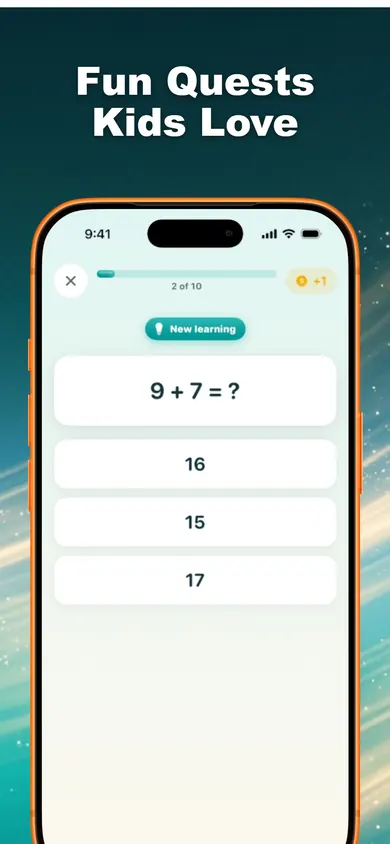
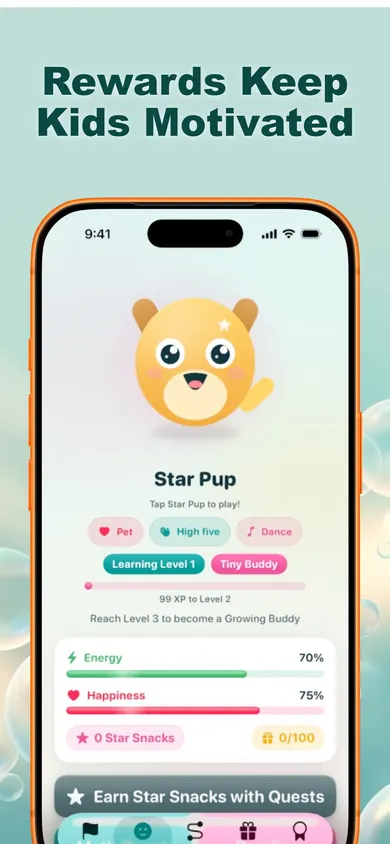
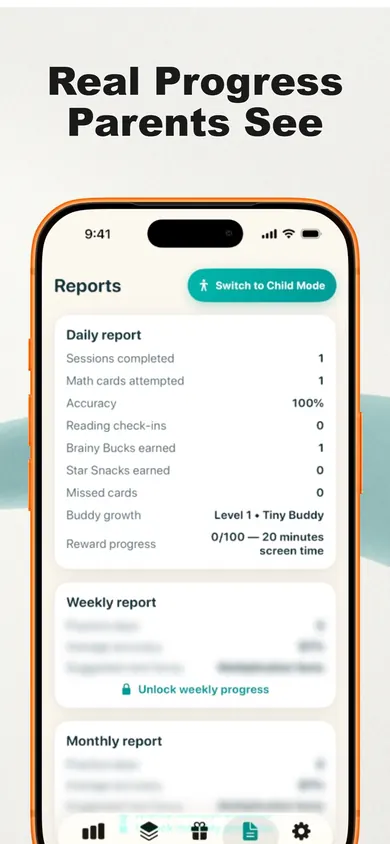
Free is real: one adaptive quest a day, 3 extra quests, hints, second tries, spaced review and the weekly summary. Brainy Bucks Plus (monthly, yearly or lifetime) adds unlimited quests, the full practice library and more reports.
Run the test on us
Give it two minutes and the four questions. If we fail, you have lost nothing. Get Brainy Bucks free.

Updated November 2026.
Related
- Brainy Bucks: a math and reading app for kidsA math and reading app for kids from Pre-K to Grade 8: one free adaptive quest a day, a weekly plan for parents, no ads, no accounts.
- When your child keeps forgetting math factsAced it Friday, blank by Monday? Why kids forget math facts, what a federal research guide recommends, and a one-week story of fixing it.
- Free math and reading apps for kindergarten, comparedFive kindergarten math and reading apps checked against their App Store listings, November 2026: what free really includes and who should pick which.
- Free math tutoring for kids: 5 mistakes to skipLooking for free math tutoring for your child nearby? Five mistakes parents make, the free help many libraries offer, and a weekly-minutes calculator.