Stop reteaching last month. Start five-minute spiral review.
For homeschool parents on a mastery curriculum: add spiral review without switching programs.
Tap a card to flip the myth.
Free on iPhone · one quest a day free
How do you add spiral review to homeschool math?
Add spiral review to homeschool math by keeping your current lessons and starting each math session with four to six mixed problems from earlier chapters, revisited the next day, a week later and about a month later. That is it. No new curriculum, no second workbook required.
The reason it works is not a homeschool philosophy, it is memory research. The US Department of Education's Institute of Education Sciences practice guide (2007) recommends spacing learning over time, with reviews weeks to months after first teaching, and rates frequent quizzing to re-expose students to key content as strongly supported. Mastery curricula are very good at the first exposure. They often leave the second, third and fourth to you. Mixing topics helps as well: in a classroom study, mixed (interleaved) math assignments led to better later test scores than assignments that practiced one kind of problem at a time (Rohrer, Dedrick & Stershic, 2015).
Mastery is how a skill arrives. Spiral review is how it stays.
We wrote this page for one parent in particular: the one whose child aced the subtraction unit in September and stared blankly at a borrowing problem in November. That child is not behind. The skill just did not get a return visit.
Spiral review for homeschoolers: a worked spacing calendar
Here is a real week, built for a third grader in a mastery program who is now on fractions. Each review problem is tagged with when it was taught. You can copy this structure onto an index card.
Day
New lesson
Warm-up (5 problems)
Mon
Unit fractions
2 from last Friday (equal parts), 2 from a week ago (multiplication facts), 1 from September (borrowing)
Tue
Comparing fractions
2 from Monday, 2 from a week ago, 1 from October (rounding)
Wed
Fractions on a number line
2 from Tuesday, 2 from a week ago, 1 from September (place value)
Thu
Equivalent fractions
2 from Wednesday, 2 from a week ago, 1 telling time
Fri
Unit check
Only the problems missed this week
The pattern is the IES spacing idea made small: yesterday, last week, last month. Friday's missed-only set is the part most parents skip and the part that pays most.
What Brainy Bucks does for the review layer
If you would rather not write five problems every night, this is the job we built Brainy Bucks to do. Today's Quest is a 5, 10 or 15 minute mix of new skills, review and earlier mistakes. Missed questions come back in later quests, and skills that went well are checked again days later to see if they stuck. A wrong answer gets a clue and a second try, with no red X.
Screens from the app
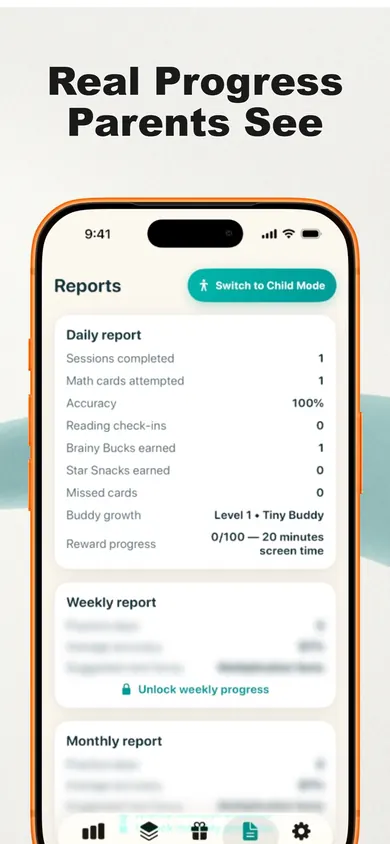
Today's Quest, about 10 minutes, on the home screen.One question at a time, big answer buttons.The parent report. Weekly and monthly detail are part of Plus.Quest complete: what was practiced and for how long.
Three ways to add spiral review, compared
Write your own warm-up
Cost: free. Your time: 10 minutes a night. Best for: parents who like control and know exactly what was taught when.
Spiral review workbook
Cost: a printed book per grade. Your time: low. Catch: its order rarely matches your curriculum, so some pages review things not yet taught.
Brainy Bucks (we make it)
Cost: one adaptive quest a day free. Your time: none to prepare. Catch: it is screen time, and you do not hand-pick topics in the free quest.
Who should pick something else: if your child does best on paper, or you want review that follows your book chapter by chapter, write your own warm-up. It is the most precise option and it is free.
Homeschool spiral review questions
What is spiral review in math?
Spiral review means mixing a few problems from earlier topics into regular practice, so old skills come back at intervals instead of being learned once and dropped.
Can I use spiral review with a mastery curriculum?
Yes, and many homeschool parents do. Keep the mastery lessons for new material and add a short daily set of mixed review problems from past chapters. The two do different jobs: mastery for learning, review for keeping.
How often should I review old math topics?
Research favors spacing: the IES practice guide recommends reviewing key content weeks to months after first teaching it (IES, 2007). A simple homeschool rhythm is the next day, one week later and about a month later.
How long should spiral review take each day?
Five to ten minutes is plenty for most elementary students. Four to six mixed problems is enough to show what has slipped without turning review into a second math lesson.
Is Brainy Bucks a homeschool math curriculum?
No. It is a practice app for math and reading, Pre-K to Grade 8, deepest from Kindergarten to Grade 4. It does not teach your curriculum's lessons in order. It works as the daily review layer beside whatever you use.
Is Brainy Bucks free for homeschoolers?
One adaptive Today's Quest every day is free, plus 3 extra quests a day, hints, second tries, spaced review and the weekly summary. Brainy Bucks Plus (monthly, yearly or lifetime) adds unlimited quests, the full practice library and up to 4 child profiles with Family Plus.
Does the app share my child's data?
The listing says learning data stays on the device, with no accounts, no ads, no chat and no third-party analytics. Purchases and settings sit behind a parent PIN.
How to start tonight in 3 steps
Install and set up a child profile. No account. Child Mode hides prices; settings sit behind your parent PIN.
Run one 5-minute quest before the lesson. Let the quest pick the mix. Use read-aloud for an early reader.
Read the weekly summary on Sunday. One sentence on what was practiced, plus up to three suggestions you can accept, replace or postpone. Statuses come only from answers in the app; they are not a formal assessment.
November, a kitchen table (a story we wrote)
A homeschooling parent finishes the fractions intro and assigns a word problem that needs borrowing. Her son freezes. He knew this in September. She does not reteach the unit. Instead, the next morning, math starts with a five-minute quest while she makes coffee. The borrowing question comes back on Thursday and again the following week. By the end of the month the Sunday summary lists subtraction as Consistent, and the fractions lesson stays on schedule.
One design decision we made: Brainy Bucks never takes coins away for a wrong answer. Review only works if a child is willing to see the old problem again.
Updated November 2026. Research cited: IES Practice Guide (2007); Rohrer, Dedrick & Stershic, Journal of Educational Psychology (2015). Brainy Bucks was created by an Ontario Certified Teacher and is not affiliated with the Ontario College of Teachers or any school board.
When your child keeps forgetting math factsAced it Friday, blank by Monday? Why kids forget math facts, what a federal research guide recommends, and a one-week story of fixing it.