
How do you teach kids a family emergency plan?
Teach it in three small pieces, one per week: who to text, where to meet, and how to find the paper copy, then practice with a short drill until your child can say each answer without help. Long talks fade. A two-minute game repeated a few times sticks.
The pieces come straight from Ready.gov's Make a Plan page for kids (checked November 2026): pick the same contact person for every family member, preferably someone outside your area who may be easier to reach in a disaster; text instead of calling; write contacts down and keep copies in a wallet or backpack; set meeting places at home, in the neighborhood and outside town; and hold regular household meetings to practice.
Kids don't need the whole plan. They need three answers they can say out loud.
What kids should know, by age
This is how we would split the plan. It is our suggestion, not an official standard: move your child up or down a row based on what they can repeat a week later.
| Age | Can usually hold | Practice it like this |
|---|---|---|
| 4 to 6 | How to get out, and the spot outside where we wait | Walk to the spot together and give it a silly name |
| 7 to 9 | One phone number, two meeting places, where the backpack card is | Say the number while doing jumping jacks; find the card with eyes closed |
| 10 to 12 | The out-of-town contact, the text rule, which neighbor can help | Let them send a practice text to the contact |
| 13 and up | The whole plan, plus helping a younger sibling | Let them run the drill on the rest of the family |
Match the plan to the child, not the child to the plan.
A family emergency plan for kids in three weeks
- Week 1: the person. Choose one contact for everyone. Write the number on a card in each backpack. Your child texts them hello so the name is real.
- Week 2: the places. Walk to the meeting spot near home. On the weekend, drive past the place outside the neighborhood and point at it.
- Week 3: the drill. Play the 20-second drill at dinner. Whatever comes back as "not yet" is next week's only lesson.
One piece a week is slow on purpose. It is also the version that gets finished.
Who Family Ready is not for
We make Family Ready, so here is the honest version. It is an organizer for the adult who keeps the plan: an Emergency Card for each person, household plan sections, a kit checklist with an optional section for children, and a printable Emergency Snapshot PDF. It is not a kids' learning app.
- If you want something your child plays alone, a game will hold their attention better. Ready.gov has free kids' games and activities.
- If you want the plan shared across two parents' phones, that is household sync and trusted-person invitations, which are part of the paid Family Ready Plus subscription.
- If you want an app that alerts or calls anyone, Family Ready never calls or messages anyone automatically and does not contact emergency services.
Parents' questions about kids and emergency plans
At what age can a child learn the family emergency plan?
Most preschoolers can learn one thing: how to get out and where to wait. Early school-age children can add a phone number and a second meeting place. Older kids and teens can hold the whole plan and help a younger sibling. Go by what your child can repeat back a week later, not by age alone.
What should kids memorize in an emergency plan?
One trusted adult's phone number, the family meeting place near home, and the backup place outside the neighborhood. Ready.gov also suggests writing contacts down and keeping a copy in a backpack, so memory is not the only copy.
How do I talk about emergencies without scaring my child?
Keep it practical and short, the same way you teach crossing the street. Talk about what the family will do, not about what might go wrong. A ten-minute practice followed by something fun works better than one long talk.
How often should we practice?
Ready.gov recommends regular household meetings to go over and practice the plan. A short drill each school term, plus one whenever something changes (new school, new caregiver, a move) is a pattern most families can keep.
Why should kids text instead of call during an emergency?
Ready.gov's advice to kids is text, don't talk: a text can get through when phone lines are busy, and it frees the line for emergency calls.
Can my child use Family Ready?
Family Ready is built for the adult who keeps the plan. You can make an Emergency Card for your child, list dependants in the household plan and print a free Emergency Snapshot PDF. It does not include games or lessons for kids.
Paper plan, school form or app: what works for teaching kids
Fridge sheet
Kids see it daily. Gone if you leave the house in a hurry.
Ready.gov kids form
Free, printable, made for children to fill in with you. Needs re-printing when things change.
Family Ready
Your copy on your iPhone, offline, plus a free dated PDF to print for each backpack.
Use more than one. The app keeps it current; the paper goes where the kids go.
What to do with your drill result
The drill above keeps a list of every "not yet." That list is your teaching plan. If your child missed the meeting place, walk there this week. If they missed the phone number, put it on a card and quiz once a day at breakfast. If they got all six, let them run the drill on you next time; teaching it back is the best check there is.
One design decision we made in Family Ready fits here: the Emergency Card asks who to call first before anything else. That is the same first thing your child learns, so your card and their backpack card say the same name.
How it works in Family Ready, in three steps
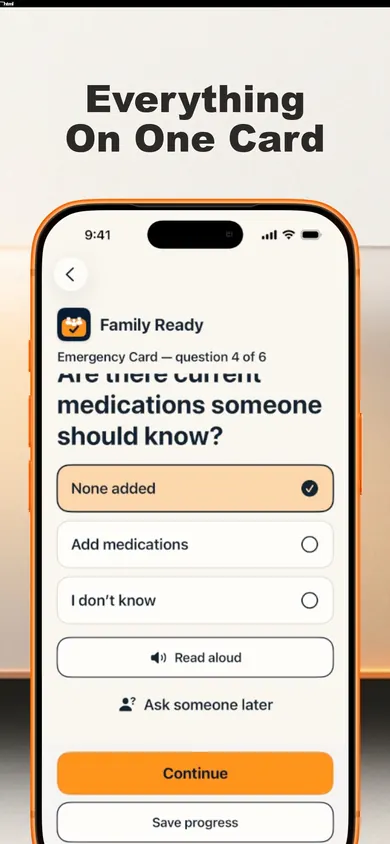
- Make your child's Emergency Card. Who to call first, allergies, medications and health details. It is free and opens offline.
- Fill in Dependants and pets. Add which school, which caregiver, and the meeting places you chose. Skip anything that does not apply.
- Print the Emergency Snapshot PDF. Free and dated, so the backpack copy shows when it was last checked. Set a 3, 6 or 12-month review to remind you to re-teach.
Teach the first piece this week
Make the card, print the copy, play the drill on Friday. Get Family Ready free on the App Store.

Updated November 2026 · Family Ready organizes what you enter. In an emergency, call your local emergency number.
Related
- Family Ready: a family emergency plan on your iPhoneA family emergency plan you build at your own pace: a free offline Emergency Card, household plan sections and a kit checklist. Free on iPhone.
- Emergency plan for single parents: the first weekWhen you are the only adult at home, the plan has to cover you being the emergency. A 7-day first-week plan for single parents, one small task a day.
- File of Life vs Medical ID, hour by hourA fridge packet, an iPhone Medical ID or an app card: one morning with an older parent shows where each works, where each fails, and why to keep two.
- Pet emergency kit checklist you can tick offA free pet emergency kit checklist from Ready.gov guidance: tick items, watch the ring fill, and see what is still missing for your dog or cat.