What should an emergency plan for dementia caregivers include?
A dementia emergency plan needs a named backup caregiver, a kit packed for this person (not an average adult), copies of papers, a recent photo, ID they wear, and a rule that you stay with them. That is the short form of the National Institute on Aging's caregiver tip sheet. Every fix in the checklist above comes from it.
The longer truth is that most plans are written by the caregiver, for the caregiver. They work as long as you are standing in the kitchen. The mistakes below are the places where that assumption breaks.
Plan for the day the caregiver is the one who cannot come.
Honest limits first
- Family Ready organizes what you type in. It does not track location, detect wandering, or alert anyone.
- It never calls or messages anyone by itself. In Emergency Mode you tap a contact to start the call.
- Free: the Emergency Card, Emergency Mode, offline access, the household plan, the kit checklist, encrypted backup and the dated Emergency Snapshot PDF.
- Paid (Family Ready Plus, monthly or annual): inviting trusted people to view chosen sections, household sync, guided reviews, date reminders, and extra printable packs such as Caregiver Handoff and Doctor Visit.
Where the six fixes go in Family Ready
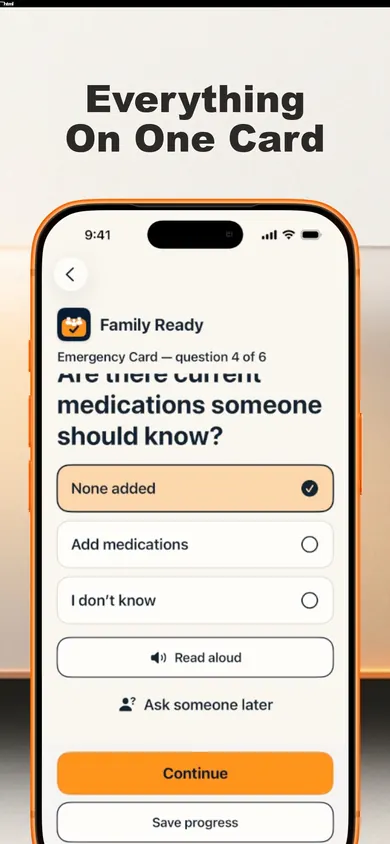 Fix 4: meds go here"I don't know" is allowed
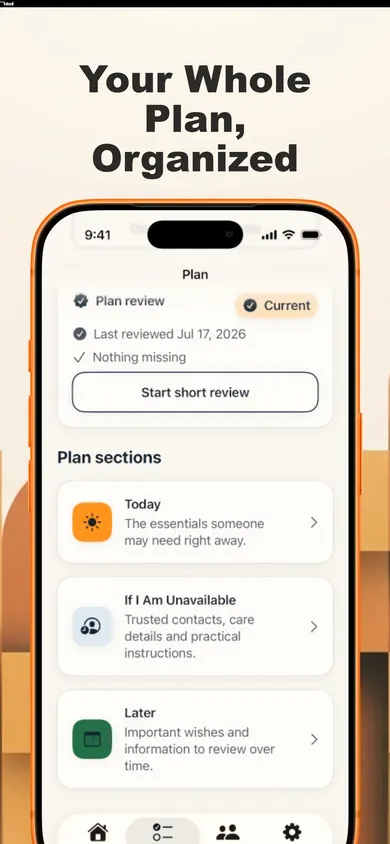 Fix 1: backup caregiverFix 3: papers, later
Our reading of the app's own sections: the backup person and care routine belong under If I Am Unavailable, documents under Later, and the medication list on the Emergency Card itself, which opens offline once you are past the lock screen. The kit checklist has an optional older-adults section to start from.
Paper binder, phone note or app?
| Paper binder | Notes app | Family Ready | |
|---|---|---|---|
| Works with no signal | Yes | Usually | Yes, offline |
| Works if the phone dies | Yes | No | Only the printed Snapshot |
| Guided questions | No | No | Yes |
| Large-text crisis screen | No | No | Yes, Emergency Mode |
| Share chosen parts only | Photocopy pages | All or nothing | Plus subscription |
| Cost | A binder | Free | Free core; Plus is paid |
Our honest recommendation is both: the app to build and update the plan, and the printout on the fridge. A binder you never update is the most common mistake of all.
A Saturday that went fine (a story we wrote)
A caregiver wakes with a fever she cannot shake and needs urgent care herself. Her mother, who has Alzheimer's, cannot be left alone. Her brother lives forty minutes away; the neighbor two doors down has a key.
Because the plan named the neighbor, the neighbor comes over and stays. Because the Emergency Snapshot was taped inside the cupboard, she finds the medication list and the note that Mom calms down with the radio on and a cup of tea. Because the photo in the kit is from last month, nobody needs it, which is the best outcome for a photo. The brother arrives by noon.
Nothing heroic happened. That is the point of a plan.
Who this is not for
If your main worry is wandering, you need ID and location tools, and a conversation with the care team, not a planning app. If your family member lives in a memory care facility, the facility's own emergency plan comes first; ask for a copy. And if anyone in the house uses Android only, a printed plan will serve everyone better than an iPhone app.
One design decision we made: every question in Family Ready accepts "I don't know" or "Ask someone later." Caregivers rarely have the insurance number to hand, and a plan that blocks on question 4 never gets finished.
Caregiver questions
What should be in an emergency kit for someone with dementia?
On top of the usual water, food and flashlight, NIA's caregiver tip sheet lists incontinence undergarments and wipes, something the person can hold, favorite snacks and high-nutrient drinks, the doctor's contact details, copies of legal, medical, insurance and Social Security papers, recent photos, warm clothing and sturdy shoes, spare glasses and hearing-aid batteries, and medications, all in a watertight container (NIA).
Who should have a copy of a dementia emergency plan?
At least one backup caregiver, plus anyone who might step in at short notice: a neighbor with a key, an adult child, a respite worker. Give them the paper version, not just a phone number.
What do I do with someone with dementia during an evacuation?
Stay with them. NIA advises not to count on the person staying in one place while you get help, to be sensitive to their emotions, and to stay close, offer your hand or a reassuring hug (NIA).
What happens if the caregiver is the one who gets sick?
That is the gap this page is mostly about. Write down who steps in, where the medication list is, the daily routine, and what calms the person. In Family Ready, the free household plan has a care instructions section, and the free Emergency Snapshot PDF prints it.
Is there a helpline for dementia caregivers?
Yes. In the US, the Alzheimer's Association runs a free 24/7 Helpline at 1-800-272-3900. In an emergency, call 911 or your local emergency number.
Does Family Ready track someone who wanders?
No. Family Ready has no location tracking or alerts. It organizes the information you enter and keeps an Emergency Card that opens offline. For wandering, talk to the care team about ID and locating services.
Get Family Ready free and start with the card
Twenty minutes for the six fixes. The Emergency Card is free and never needs a subscription. See Family Ready on the App Store.

Updated November 2026. Guidance quoted from the National Institute on Aging. Family Ready is not an emergency-response, medical or monitoring service. In an emergency, call 911 or your local emergency number.
Related
- Family Ready: a family emergency plan on your iPhoneA family emergency plan you build at your own pace: a free offline Emergency Card, household plan sections and a kit checklist. Free on iPhone.
- Emergency plan for single parents: the first weekWhen you are the only adult at home, the plan has to cover you being the emergency. A 7-day first-week plan for single parents, one small task a day.
- Emergency preparedness quiz for seniorsSeven scratch cards built from Ready.gov's advice for older adults. Scratch to see why each matters, answer, and get a short to-do list.
- File of Life vs Medical ID, hour by hourA fridge packet, an iPhone Medical ID or an app card: one morning with an older parent shows where each works, where each fails, and why to keep two.