
Who should be my child's emergency contact?
Your child's emergency contact should be an adult who answers during the school day, can reach the school or childcare quickly, and knows your child's allergies and medicines, with one out-of-town person as a backup for big emergencies. Distance and love matter less than whether they pick up at 11:40 on a Tuesday.
That last part comes from Ready.gov's family plan guidance (last updated 2023): "Pick someone out of town. They may be easier to reach in a disaster," and pick the same person for every family member. The CDC (2024) adds that a family plan should hold phone numbers, emergency contacts and more than one meeting place.
The decision flowchart: which line does each person go on?
Run each name through these five questions. Stop at the first answer that places them.
Do they usually answer their phone between drop-off and pickup?
YesKeep going.
NoNot a first or second line. Check question 5.
Could they get to the school or childcare in about 30 minutes?
YesKeep going.
NoSkip to question 5: they may be your out-of-town contact.
Will the school release your child to them?
YesKeep going.
No or unsureSchools set their own release rules. Ask the office what they need, then add them.
Do they know your child's allergies, medicines and doctor?
YesPickup backup. Put them on line two.
NoStill line two, once you hand them a written card.
Do they live outside your area and stay calm under pressure?
YesOut-of-town contact for the whole family.
NoThank them and leave them off this form.
Questions 1 to 4 are our order of priorities. Question 5 follows Ready.gov (2023). Line numbers depend on your school's form.
| Line | Job | Best fit |
|---|---|---|
| 1 | Decide and answer | Parent or guardian |
| 2 | Collect your child today | Nearby adult who picks up |
| 3 | Relay news in a big emergency | Out-of-town relative or friend |
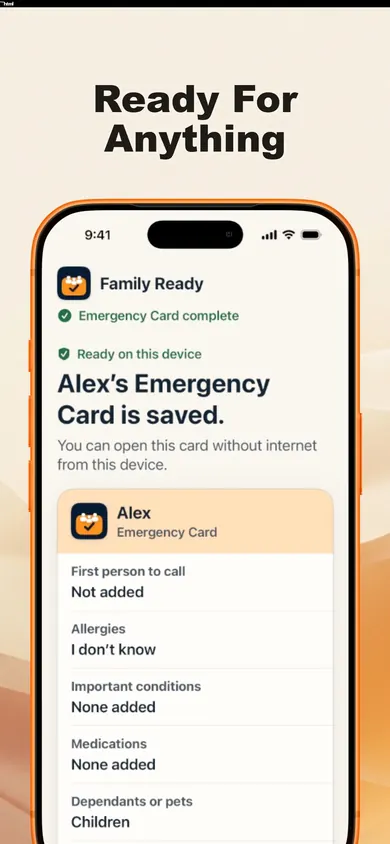
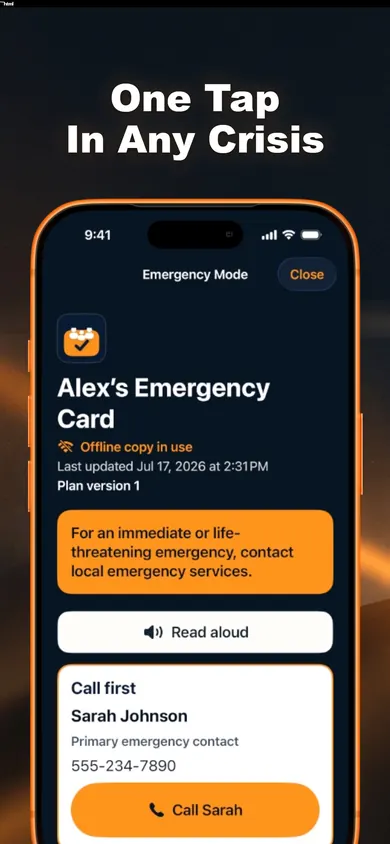
Where those names go in Family Ready
Honest limits
- Family Ready does not update your school's records. You still fill in the school's own form or portal.
- It is not an emergency service and never contacts anyone for you. In an emergency, call your local emergency number.
- A phone can be lost or flat. Keep a printed copy too: the dated Emergency Snapshot PDF is free.
- Free: the Emergency Card, Emergency Mode, offline access, the household plan, the kit checklist and the Snapshot PDF. Family Ready Plus (monthly or annual) adds trusted-person invitations, household sync and extra printable packs such as the Caregiver Handoff.
How to set your child's contacts in 3 steps
- Make your child's Emergency Card. Six short questions: who to call first, allergies, conditions, medications. "I don't know" and "Ask someone later" are real answers.
- Ask your line-two person. A two-minute conversation. Then tell the school office and add them to the card.
- Print one copy for them. The free Emergency Snapshot PDF is dated, so everyone can see whether it is current. Choose a 3, 6 or 12-month review so it stays that way.
A contact who has never seen the allergy list is half a contact.
Questions parents ask about emergency contacts
Who should be my child's first emergency contact?
Usually a parent or guardian. The first contact on a school or childcare form should be someone who answers during the school day and can make decisions for your child. If that is you, the next line matters more: pick the adult who can actually get there.
Should a grandparent be an emergency contact?
Often, yes, if they answer their phone, can drive or travel to the school, and know your child's allergies and medicines. A grandparent who lives far away can be a strong out-of-town contact instead, which Ready.gov (2023) suggests every family pick.
How many emergency contacts should a child have?
Most school forms ask for two or three. A simple pattern is one parent or guardian, one nearby adult who can collect your child, and one out-of-town person the whole family checks in with. Your school's form sets the real limit.
Can a neighbor be my child's emergency contact?
Yes. A neighbor who works from home can be the best pickup backup you have. Ask them first, tell the school office, and give them your child's allergy and medicine details in writing.
What is an out-of-town emergency contact for?
In a disaster, local phone lines can be busy. Ready.gov (2023) suggests picking someone out of town because they may be easier to reach, using the same person for every family member, and texting rather than calling.
Should my child memorize emergency phone numbers?
The CDC (2024) suggests helping older children memorize the names and phone numbers of parents and other trusted adults, and also suggests an emergency contact card kept in the school bag.
Does Family Ready contact the school or call anyone for me?
No. Family Ready organizes information you enter. It never calls or messages anyone automatically, and it is not an emergency service. In an emergency, call your local emergency number.
Who this page and Family Ready are not for
If you need live location sharing or a device that calls for help on its own, look at a medical alert service or your phone's built-in location sharing instead; Family Ready does neither. If your school runs everything through its own app, update that first. And if a custody order says who may collect your child, the court paperwork and the school's office decide, not a flowchart.
One design decision we made on purpose: Emergency Mode has large text, high contrast and no purchase prompts, ever. A babysitter holding a phone in a crisis should never see a paywall.
A Tuesday at 11:40 (a story we wrote)
The nurse calls about a fever. Mom is in a meeting with her phone face down. Dad is on a flight. Line two on the form is a friend who changed jobs in spring and now works an hour away.
That evening they redo it. Line two becomes the neighbor three doors down, who works from home and said yes in about ten seconds. Line three becomes his sister, two states over, who will be the family's out-of-town contact. They update the school portal, then the Emergency Card, then print one Snapshot for the neighbor's fridge. Total time: twenty minutes, most of it finding the portal password.
Put the right names on the right lines
Make your child's free Emergency Card tonight. Open Family Ready in the App Store.

Updated November 2026. Sources: Ready.gov (2023), CDC (2024). General information, not legal advice.
Related
- Family Ready: a family emergency plan on your iPhoneA family emergency plan you build at your own pace: a free offline Emergency Card, household plan sections and a kit checklist. Free on iPhone.
- How to teach kids your family emergency planTeach kids your family emergency plan in small pieces: one contact, two meeting places, one paper copy. Plus a 20-second drill to play tonight.
- Babysitter emergency information sheet builderFill in a babysitter emergency information sheet in two minutes, run a 20-second sitter drill on it, then print one page. Free, nothing saved.
- Emergency plan for single parents: the first weekWhen you are the only adult at home, the plan has to cover you being the emergency. A 7-day first-week plan for single parents, one small task a day.