
Should screen time be a reward for kids?
Usually not as the main reward: in a 2018 study of young children, parents who used screens to reward or punish behaviour had children who spent more time on screens. The Guelph Family Health Study (Tang and colleagues, BMC Obesity, 2018) looked at families with children aged 1.5 to 5. The University of Guelph's summary (2019) quotes the lead researcher comparing it to sweets: rewarding with something raises its attraction.
That does not mean every family that trades minutes for chores is doing harm. It means the trade has a cost: the screen becomes the prize, and the task becomes the toll. The four methods above each pay that cost differently.
A reward teaches a child what you think is worth wanting.
Who this page is not for
If your child has an IEP, a behaviour plan or therapy that uses screen time deliberately, follow the professional who wrote it; a plan built for one child beats a study average. If your child is under two, the question is mostly moot; most guidance suggests little or no recreational screen time at that age. And if a reward chart is working well in your house and nobody is fighting about it, you do not need to change it because of a web page.
How to move away from screen-time rewards, in 3 steps
- Fix the screen time. Pick a daily amount and a time of day, and stop moving it up or down with behaviour.
- Swap in real-life rewards. Let your child list five things they would love that are not screens: choose dinner, a park trip, an extra bedtime story.
- Praise the effort, specifically. "You tried that tricky one twice" beats "good job". The 1999 meta-analysis found positive feedback raised interest.
What rewards look like inside Brainy Bucks
A mini story: the 20-minute treaty
A father trades 20 minutes of tablet time for every page of reading. Within a month his son reads exactly one page a day, fast, then asks how many minutes are left. Reading has become the queue for the tablet.
He changes two things: tablet time moves to a fixed half hour after dinner, no matter what, and the reading reward becomes picking the Saturday breakfast. The son grumbles for a week. Then, on day nine, he reads three pages because the story got good, and nobody paid him for the extra two.
Honest limits
- The Guelph study is cross-sectional with a small sample of mostly higher-income Canadian families. It shows a link, not cause.
- The 1999 meta-analysis is about experiments, many with college students; children's results pointed the same way, but homes are not labs.
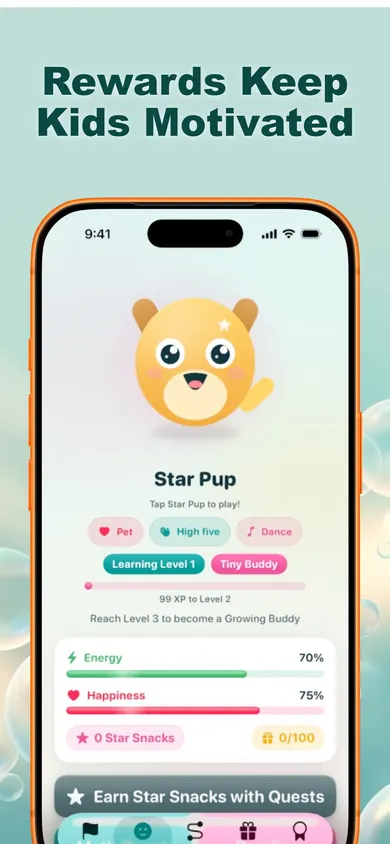
- Brainy Bucks has rewards built in. Kids earn Brainy Bucks by practicing and parents decide what they buy. We think parent-chosen, non-screen rewards fit the research best, but the app does not force that.
- Skill statuses in the app are based only on answers given in the app. They are not a formal assessment.
One design decision we made: every reward is earned by practicing and nothing is sold to children. Child Mode shows no prices or purchase buttons; purchases and rewards sit behind a parent PIN.
Screen time reward vs other methods, side by side
| Method | Quick win? | Long-term risk | Best for |
|---|---|---|---|
| Earn screen minutes | Yes | Screens become the prize | Rare, one-off pushes |
| Take screens away | Sometimes | Same link to more screen time; more arguments | Avoid as a default |
| Real-life reward | Yes | Expected rewards can dull interest | Building a new habit for a few weeks |
| Fixed schedule + praise | Slower | Lowest | Most families, most of the time |
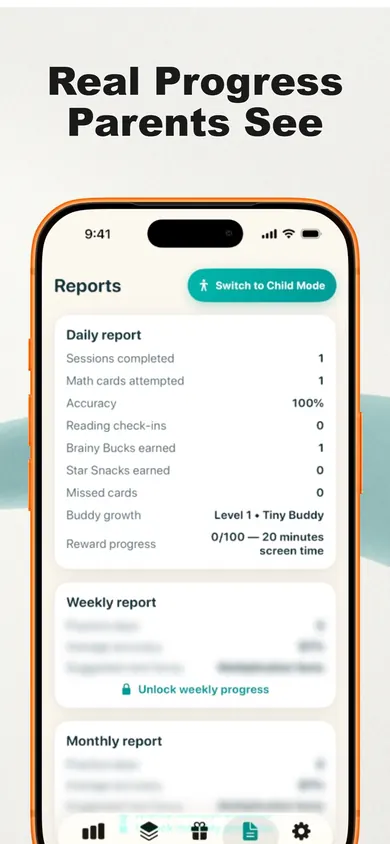
Who should pick something else: if you want practice with no reward layer at all, a printed worksheet or a library book does that. Brainy Bucks is for parents who want short daily practice, a weekly summary, and rewards they control.
Parents also ask
Is it bad to use screen time as a reward?
It tends to make screens more attractive. A 2018 Guelph Family Health Study in BMC Obesity found that parents' use of screens to control behaviour was linked with more screen time in children aged 1.5 to 5. It is a correlation, not proof, but it points the same way as research on food rewards.
Should I take away screen time as a punishment?
The same study grouped screens as reward and as punishment together as using screens to control behaviour, and both were linked with more screen time. If a limit is needed, a fixed daily schedule that does not move with behaviour avoids that problem.
What can I use as a reward instead of screen time?
Small real-life things a child chooses: picking dinner, a trip to the park, staying up 15 minutes for an extra book, a game with a parent. Specific praise for effort also works; a large meta-analysis found positive feedback raised children's interest rather than lowering it.
Do rewards kill a child's motivation to learn?
A 1999 meta-analysis of 128 studies found that expected, tangible rewards tended to reduce children's free-choice interest in an activity. Rewards that are unexpected, or simple positive feedback, did not show the same effect.
Does Brainy Bucks use screen time as a reward?
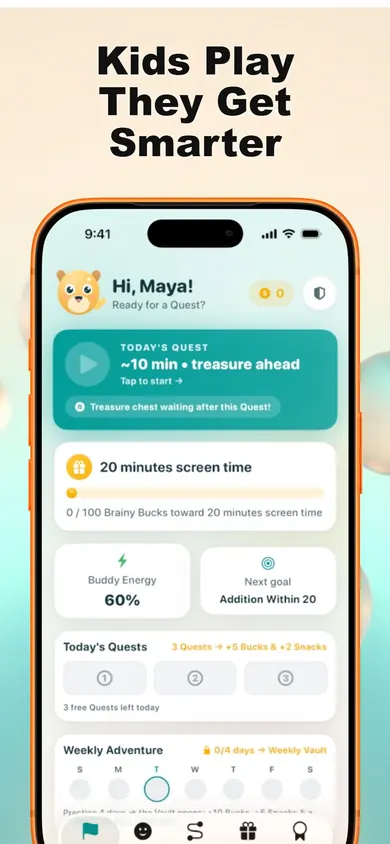
Only if you set it up that way. Parents create and price real-life rewards, redeemed only with a parent PIN. The sample on our store screenshot shows a 20 minutes screen time goal, but you can choose a park trip or a book instead. Nothing is sold to children.
How much of Brainy Bucks is free?
One adaptive Today's Quest every day, 3 extra quests a day, hints and second tries, spaced review, the weekly summary and learning plan, a Brain Buddy, one real-life reward and a starter activity set. Brainy Bucks Plus (monthly, yearly or lifetime) adds unlimited extra quests, the full library, more reports and unlimited rewards.
Updated November 2026
Pick the reward. We'll handle the quest.
One adaptive quest a day is free. You decide what Brainy Bucks buy.

Related
- Brainy Bucks: a math and reading app for kidsA math and reading app for kids from Pre-K to Grade 8: one free adaptive quest a day, a weekly plan for parents, no ads, no accounts.
- Free math tutoring for kids: 5 mistakes to skipLooking for free math tutoring for your child nearby? Five mistakes parents make, the free help many libraries offer, and a weekly-minutes calculator.
- How to get your child to practice math every dayA parent's first-week plan for daily math practice: same time, small dose, mistakes welcome. Day by day, with what to say and what to skip.
- Thanksgiving break learning activities plannerPick how many days off and how many minutes a day. Get a day-by-day table of kitchen math, menu reading and travel games for Thanksgiving break.