
What is a 12-day emergency preparedness challenge?
It is a plan that spreads getting ready across twelve days, one small task a day, so an older adult living alone finishes a working plan and kit before the holidays instead of meaning to start in spring. Each task below takes under an hour, most take ten minutes, and each one comes from Ready.gov's basic kit list or Ready.gov's page for older adults (updated 2024).
Here is the contrarian part. Most preparedness advice fails because it asks for a big shopping trip and a free Saturday. That is the bunker approach. Twelve small days asks for almost nothing on any single day, and that is why it gets finished. Small tasks finished beat a big kit still in the cart.
A mini story: the Tuesday it started
This is an example, not a real customer. Picture a 79-year-old widow in a one-floor house, with a son three states away who calls on Sundays. Every winter he asks whether she has "a plan". Every winter she says yes, meaning a drawer with a flashlight in it.
This year he sends her day 1 on the first of December: name the person to call first. She names her neighbor, and him as the out-of-area backup. On day 2 they write her medication list over the phone, pill bottle by pill bottle. On day 3 the neighbor gets a key. By the weekend there is water in the hall closet. By December 12 there is a printed page on the fridge and the same information on her phone, readable without internet. Nobody bought a bunker. They just did Tuesday.
The 12-day emergency preparedness plan, day by day
Dates are for December 2026. Miss a day? Do two tomorrow. The order matters less than finishing.
| 01Tue Dec 1 | Name your call-first person Pick one person to call first and one out-of-area backup. Write both numbers on paper too. |
|---|---|
| 02Wed Dec 2 | Write the medication list Names and doses of everything you take, plus allergies. This is the heart of the Emergency Card. |
| 03Thu Dec 3 | Hand over one spare key Ready.gov asks that at least one person has a key, knows where supplies are and how to give your medicine. |
| 04Fri Dec 4 | Water One gallon per person per day, for several days. Start with what fits the closet. |
| 05Sat Dec 5 | Food you can open Several days of food that needs no fridge, plus a manual can opener. |
| 06Sun Dec 6 | Light and sound Flashlight, extra batteries, a whistle, and a battery or hand-crank radio. |
| 07Mon Dec 7 | Medicines and supplies Add medicines and medical supplies to the kit. Ask your clinic how they handle emergencies. |
| 08Tue Dec 8 | Copy the cards Copies of Medicare, Medicaid and other insurance cards go in the kit. |
| 09Wed Dec 9 | Power for the phone Chargers and a backup battery for the phone and any device you rely on. |
| 10Thu Dec 10 | Money that still arrives Mail can stall for weeks. Ready.gov suggests direct deposit for federal benefits: 800-333-1795. |
| 11Fri Dec 11 | The pet plan Food and water for the animal, and a backup: not every shelter accepts pets. |
| 12Sat Dec 12 | Print it and practice Print one copy, put it where helpers will look, and walk one person through the plan. |
Sources: water, food, light, radio, whistle, can opener and phone power from Ready.gov's basic kit list; spare key, medicines, insurance card copies, direct deposit and pet shelters from Ready.gov's page for older adults (updated 2024).
Who this challenge is not for
- Anyone in an emergency right now. Stop reading and call your local emergency number.
- People who want someone alerted automatically. A plan and a kit do not watch over anyone. A monitored medical alert service does; this challenge does not replace it.
- Homes with power-dependent medical equipment need more than day 9. Ask the equipment supplier and the clinician what a backup plan should look like.
- Preppers who already own a year of food. You are past this page.
Where the results live: proof screenshots
We make Family Ready, so read this part knowing that. The app does not run a 12-day challenge; it is the place the answers land. Days 1 and 2 fill the free Emergency Card, which opens in Emergency Mode without internet after the phone is opened with its passcode. Days 4 to 9 tick off the free kit checklist, which is based on Ready.gov and Get Prepared (Canada) guidance and has an optional older adults section.
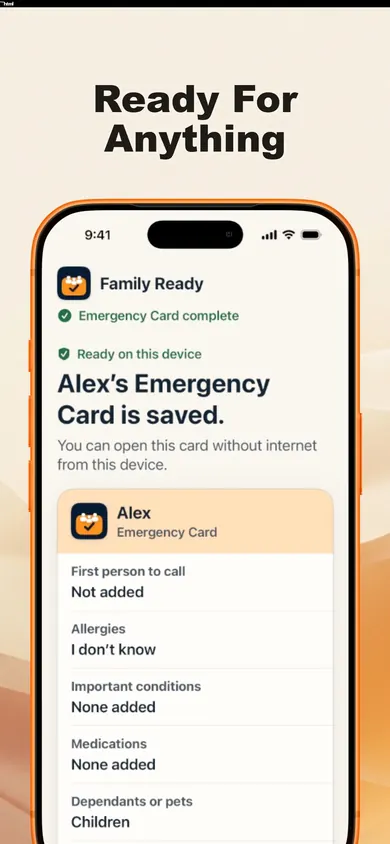
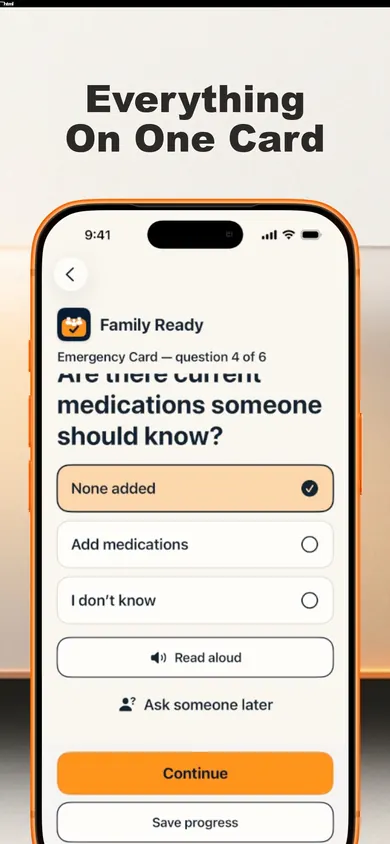
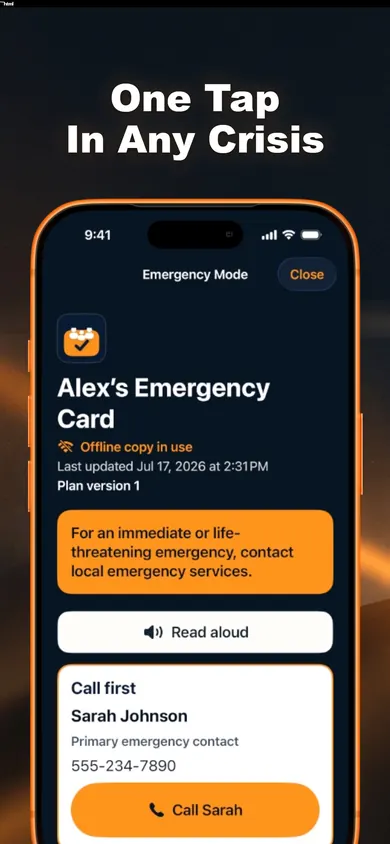
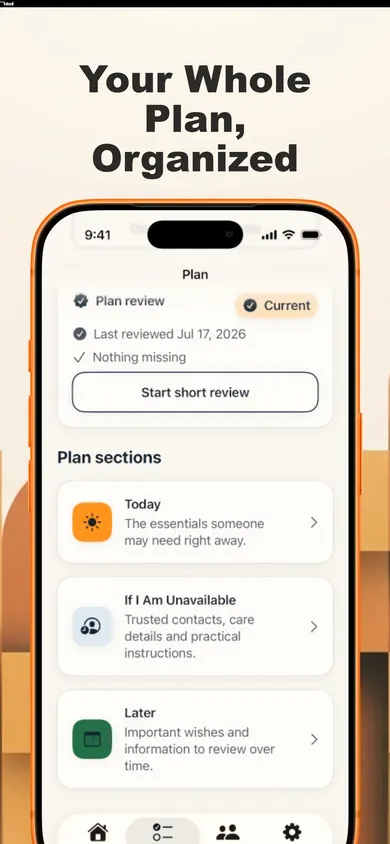
One design decision we made on purpose: Emergency Mode shows no ads, no pop-ups and no purchase prompts. A neighbor holding the phone in a hurry should only see the person's information and a call button. Family Ready never dials or messages anyone for you.
Honest limits
Free covers the whole challenge. Emergency Card, Emergency Mode, offline access, the household plan, the kit checklist, encrypted backup and the Emergency Snapshot PDF are free.
Plus is a subscription (monthly or annual). It adds inviting trusted people with permissions, household sync, guided reviews, important-date reminders, access drills and extra printable packs. You do not need it for these twelve days.
A phone is not a plan on its own. No app helps if the phone is lost or flat, which is why day 12 is printing.
iPhone only, and the plan is only as current as the last time someone updated it.
Comparison strip: three ways to get ready this December
12 small days
Ten minutes most days. Finished by Dec 12. Builds a plan and a kit together. Needs a little follow-through.
One big weekend
Fast if it happens. Tiring, easy to postpone, and the paperwork part (meds, contacts, cards) tends to get skipped.
A pre-made kit
Covers supplies in one click. Knows nothing about your medicines, your key holder or who to call first.
The kit is the easy half; the plan is the half that helps a stranger help you. If you choose the pre-made kit, still do days 1, 2, 3, 8 and 12.